What Types of Conveyor Systems Are Used in Logistics?

Time:2026-10-17 Author:Oliver
0%

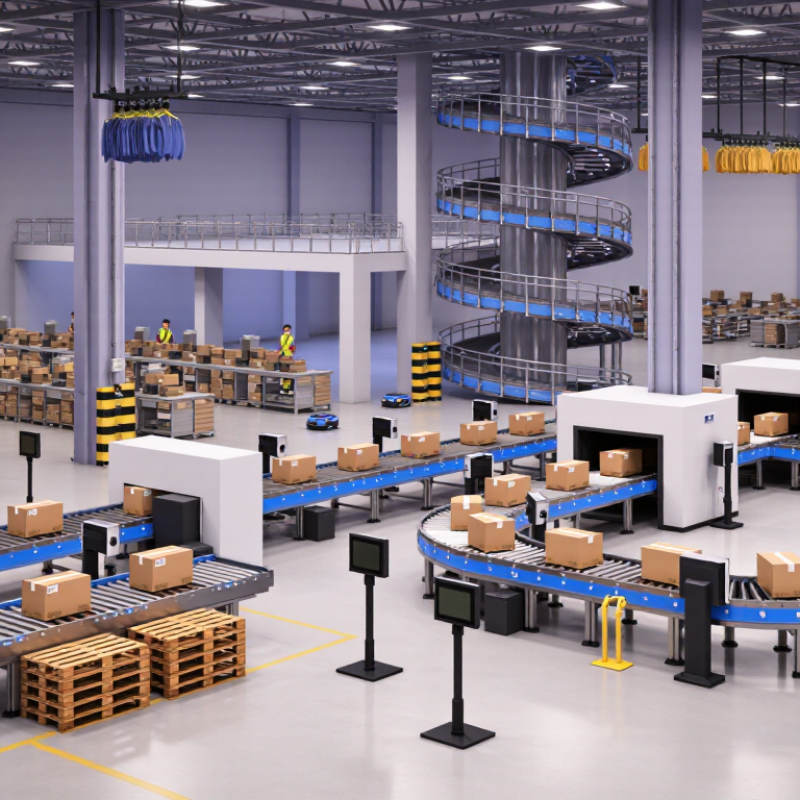
Understanding what types of conveyor systems are used in logistics begins with one practical question: what must move, where, and how often? Modern distribution centers commonly use belt conveyors for cartons, roller conveyors for pallets, and narrow-belt sorters for high-volume parcels. Spiral conveyors connect floor levels, while overhead systems move garments without consuming valuable floor space. Each choice affects speed, noise, maintenance, labor, and energy use.

The MHI 2024 Annual Industry Report found that 83% of supply-chain professionals expect greater use of robotics and automation within five years. That expectation places conveyors under sharper scrutiny. A fast belt may improve throughput, but it can also create bottlenecks at packing stations. A roller line may handle heavy loads efficiently, yet poorly aligned packages can stop the entire flow. Small details matter. Think of a barcode scanner, a transfer point, and one damaged carton.

Dr. Michael ten Hompel of Fraunhofer IML has stated, “Logistics is the science of planning, implementing, and controlling the flow of goods and information.” His point applies directly to conveyor design. Equipment should support the whole process, not merely move boxes. The Interact Analysis Warehouse Automation report also identifies strong growth in automated material-handling investment, driven by e-commerce and labor constraints. Still, automation is not automatically better. That assumption deserves reflection. The most reliable system may combine conveyors, warehouse software, manual inspection, and flexible robotic equipment. This guide examines the main conveyor types, their practical uses, and the conditions that make each system effective.
What Types of Conveyor Systems Are Used in Logistics?

Types of Conveyor Systems Used in Logistics

Logistics facilities use several conveyor systems to move cartons, totes, pallets, and parcels with less manual handling. Belt conveyors suit mixed packages because their continuous surface supports small or uneven items. Roller conveyors work well for rigid cartons, especially near packing stations and truck-loading areas. Powered rollers maintain steady movement, while gravity rollers support short, manually controlled sections.

Chain conveyors handle heavier loads, including pallets and rigid containers. Sortation conveyors divert parcels toward different docks, storage zones, or packing lines. They may use sliding shoes, pop-up rollers, or narrow belts. Vertical conveyors connect floors without occupying a long ramp area. Overhead systems can preserve valuable floor space, although installation and maintenance access require careful planning. Flexible conveyors are useful during seasonal peaks because workers can extend them near temporary loading points.

Tips: Measure package dimensions, weight, speed, and daily volume before selecting equipment. Leave access around motors, sensors, and transfer points. Small gaps can create serious jams. Test the slowest and lightest parcels, not only standard cartons. I have seen efficient layouts perform poorly when labels face sideways or cartons arrive crushed. That detail is easy to miss. Noise, cleaning needs, future expansion, and worker visibility also deserve practical review. A technically correct design may still feel inconvenient during a busy shift.

How Belt Conveyors Move and Handle Goods

Belt conveyors remain a practical choice for moving cartons, totes, and parcels through logistics facilities. A motor turns the drive pulley, pulling a continuous belt across rollers or a sliding bed. Goods travel steadily, with fewer sudden stops than many manual handling methods. MHI’s 2024 Annual Industry Report found that 88% of surveyed supply-chain professionals planned to increase technology investment in 2024. That investment often supports simple, measurable material flow.

On a warehouse floor, belt speed affects both output and product safety. A fast belt may raise throughput, but it can damage loose packaging or create gaps at scanning points. Sensors detect each carton, while adjustable guides keep packages centered. Operators also inspect belt tension, pulley alignment, and debris buildup. Small failures matter. A misaligned belt can scrape edges, increase energy use, and stop an entire line.

The International Federation of Robotics reported 541,302 industrial robots were installed worldwide in 2023. Conveyors frequently connect these systems with storage, picking, and packing areas. Their value depends on the layout, not speed alone. Designers should test real cartons, including soft bags and uneven loads. A clean test case can mislead. Actual operations include crushed corners, mixed weights, and human interruptions. Choosing the belt surface, incline, and control logic requires field measurements, not catalogue assumptions.

When to Use Roller, Chain, and Slat Conveyors

Roller conveyors suit cartons, totes, and pallets with firm, flat bases.

They work well for accumulation, sorting, and manual picking areas. Gravity rollers can move light packages without motors, while powered rollers provide steady control. Grand View Research estimated the global conveyor systems market at about USD 10.3 billion in 2023, with growth expected through 2030. That expansion reflects wider automation, but automation alone does not fix poor layout decisions.

Choose chain conveyors for heavy pallets, uneven loads, or harsh operating conditions.

Their chains grip the load directly and tolerate dirt better than many roller surfaces. Slat conveyors are better for rigid products needing stable, guided movement, such as containers, trays, and packaged goods. They also handle curves and elevation changes effectively. In practice, product shape matters more than weight alone. I have seen lightweight cartons jam because their bases were flexible. That was a design failure, not a conveyor failure. The MHI 2024 Annual Industry Report continues to identify labor availability and technology investment as major supply-chain concerns, making reliable material flow increasingly important.

Tips:

Measure the smallest package, largest pallet, load spacing, noise level, and cleaning needs before selecting equipment. Test real products, not only specifications. Leave access around drives and transfer points. A roller line may be cheaper initially, but repeated jams can erase that advantage. Chain systems need lubrication and inspection. Slat systems need careful tensioning. These maintenance details are easy to underestimate.

How Sortation and Vertical Conveyors Improve Material Flow

In logistics, conveyor selection depends on load shape, distance, speed, and control requirements. Belt conveyors handle cartons and irregular packages with steady traction. Roller conveyors suit rigid boxes and accumulation zones. Chain conveyors support heavier loads, but they need careful guarding and maintenance. Sortation conveyors add another decision layer. They direct parcels toward chutes, docks, or picking areas. A reliable system combines sensors, scanners, divert mechanisms, and software rules. In site assessments, I look for package gaps, label position, and peak-hour volume. Small errors there can cause repeated misroutes.

Small gaps matter.

Vertical conveyors improve flow when a facility has multiple storage or processing levels. They move cartons between floors without consuming long ramps. Reciprocating lifts work well for controlled, scheduled transfers. Continuous vertical units can support higher throughput when loading remains balanced. Safety interlocks, guarding, emergency stops, and load-rated platforms are essential. Operators also need clear access for inspection and cleaning. A vertical conveyor should connect with upstream and downstream controls, not operate alone. I have seen layouts fail because the lift was fast, but staging space was too small.

Speed did not solve the bottleneck.

Engineers should test real cartons, damaged labels, uneven spacing, and start-stop conditions before acceptance.

No design is perfect. Regular measurement still matters.

Factors for Selecting a Conveyor System in Logistics

Selecting a conveyor system begins with the shipment, not the equipment catalogue. Measure package length, width, weight, surface, and daily volume. A parcel with a soft base may need belt support, while rigid cartons can suit roller conveyors. For mixed items, modular systems offer flexibility, but they can require more complex controls. Start with real order data.

Throughput must match both average and peak demand. MHI’s 2024 Annual Industry Report projects robotics and automation adoption to reach 72% within five years. That figure signals stronger automation demand, yet it does not justify automating every process. Calculate cartons per minute, accumulation space, transfer points, and loading delays. A system designed only for average volume may fail during seasonal surges. Peak capacity matters.

Layout and maintenance deserve equal attention. Check ceiling height, aisle clearance, emergency access, noise, and future expansion space. Energy use also matters, especially when conveyors run for long shifts. Specify variable-speed operation and zones that stop when empty. Safety guards, accessible controls, and clear inspection points should be included from the design stage. Do not hide service areas behind storage racks. That mistake is common. A digital simulation can expose bottlenecks, but field testing remains essential. My practical concern is simple: forecasts are often too optimistic. Select a system that workers can understand, maintain, and adjust without creating fragile dependencies.

What Types of Conveyor Systems Are Used in Logistics? - Factors for Selecting a Conveyor System in Logistics

Conveyor System Type Typical Logistics Applications Suitable Load and Product Conditions Main Advantages Important Limitations Key Selection Factors
Belt Conveyor Order picking, parcel handling, loading and unloading, airport baggage handling, and movement between warehouse zones. Cartons, totes, bags, parcels, and irregularly shaped items; commonly used for light to medium loads. Provides continuous transport, good product support, flexible layouts, and the ability to handle inclined or declined movement. The belt can wear or track incorrectly; some products may slide on steep inclines; cleaning and belt replacement require planned maintenance. Belt material, product dimensions, load weight, incline angle, speed, accumulation needs, and cleaning requirements.
Roller Conveyor Pallet transport, carton conveying, shipping areas, receiving docks, and accumulation before packing or sortation. Rigid-base products such as cartons, crates, totes, and pallets with a reasonably flat bottom. Durable, modular, easy to extend, and available in gravity, powered, and accumulation configurations. Poor performance with soft-bottom, unstable, very small, or irregular products; gaps between rollers can cause product hang-ups. Product base condition, roller pitch, load distribution, conveyor width, accumulation control, and required throughput.
Chain Conveyor Pallet transfer, heavy-unit handling, production-to-warehouse transfer, and applications requiring positive movement. Heavy pallets, bins, containers, and products with a stable underside or designed support points. High load capacity, reliable traction, and suitability for demanding industrial environments. Generally noisier than belt systems, requires lubrication and chain maintenance, and may mark delicate product surfaces. Load weight, pallet design, chain configuration, transfer spacing, operating environment, noise limits, and maintenance access.
Motor-Driven Roller Conveyor Automated distribution centers, accumulation zones, order consolidation, packing lines, and shipping sortation. Cartons, totes, cases, and pallets with a rigid and relatively flat base. Supports controlled accumulation, zoning, variable speeds, reversing, and integration with sensors and warehouse controls. Higher purchase and control-system costs than gravity conveyors; requires electrical components and systematic troubleshooting. Required control logic, zone length, product spacing, load per zone, speed range, energy use, and system integration.
Sortation Conveyor Parcel hubs, e-commerce fulfillment, distribution centers, outbound order routing, and carrier or destination separation. Identifiable cartons, totes, and parcels within defined weight, size, and shape limits. Routes products automatically to multiple destinations and improves throughput consistency when paired with scanning and control software. More complex and costly; performance depends on accurate identification, suitable product geometry, and well-designed controls. Number of destinations, peak throughput, scan rate, product size range, divert accuracy, recirculation needs, and available floor space.
Flexible Conveyor Temporary dock operations, truck loading and unloading, cross-docking, and facilities with frequently changing layouts. Cartons, parcels, and bags that can be manually placed and removed. Can be extended, retracted, curved, and repositioned to serve different doors or work areas. Usually has lower capacity and less precise product control than fixed automated systems; manual handling may remain necessary. Required reach, mobility, conveyor width, operator ergonomics, load range, storage position, and frequency of relocation.
Vertical Conveyor Movement between warehouse floors, mezzanines, platforms, picking levels, and elevated packing or storage areas. Cartons, totes, bins, pallets, and other unit loads compatible with the platform or carrier design. Uses building height efficiently and reduces the need for long ramps or manual lifting between levels. Often has lower continuous flow than horizontal conveyors; requires guarding, safety controls, and suitable loading and unloading interfaces. Vertical lift height, load size, cycle rate, floor openings, safety requirements, footprint, and integration with horizontal conveyors.
Overhead Conveyor Garment distribution, hanging products, light assembly transfer, and applications where floor space must remain clear. Items that can be safely suspended from carriers, hooks, or trolleys. Preserves floor space, supports routing above work areas, and can provide buffer storage or sequenced delivery. Requires adequate ceiling structure and clearance; installation and maintenance can be difficult at height. Ceiling height, structural capacity, carrier design, product stability, route layout, access for maintenance, and safety guarding.
Core Selection Checklist: Define the product dimensions and weight, required throughput, peak demand, travel distance, elevation changes, accumulation method, available floor space, safety requirements, integration needs, energy consumption, maintenance access, and total cost of ownership before selecting a conveyor system.

FAQS

Which conveyor is suitable for mixed cartons, totes, and parcels?

Belt conveyors support uneven and small items on a continuous surface. They provide steady movement. However, soft bags may need real-world testing.

When should a facility choose roller conveyors?

Roller conveyors suit rigid cartons near packing stations and loading areas. Powered rollers maintain movement. Gravity rollers work for short, manually controlled sections.

What type of conveyor handles pallets and heavy containers?

Chain conveyors handle heavy pallets and rigid containers. Their structure must match the load weight. A weak design may create delays.

How do sortation conveyors direct parcels?

Sortation conveyors divert parcels toward docks, storage zones, or packing lines. They may use sliding shoes, pop-up rollers, or narrow belts. Labels and carton position still matter.

Why are vertical conveyors useful in logistics facilities?

Vertical conveyors connect floors without requiring a long ramp. They save floor space. Transfer points need careful testing.

When are overhead conveyor systems a practical option?

Overhead systems preserve valuable floor space. Installation access and maintenance routes require careful planning. Hidden service problems can become expensive.

Why are flexible conveyors useful during busy seasons?

Flexible conveyors extend near temporary loading points. They support seasonal volume changes. Their convenience may hide awkward worker movement.

What should be measured before selecting a conveyor system?

Measure package dimensions, weight, speed, and daily volume. Test light parcels and damaged cartons. Standard boxes are not enough.

What maintenance details affect conveyor performance?

Inspect belt tension, pulley alignment, sensors, motors, and debris buildup. Small gaps can cause serious jams. Cleaning needs deserve attention too.

Can a technically correct conveyor layout still perform poorly?

Yes. Sideways labels, crushed corners, mixed weights, and interruptions can reduce performance. The layout may look efficient. The shift may disagree.

Conclusion

Understanding what types of conveyor systems are used in logistics is essential for designing an efficient material-handling operation. Belt conveyors are widely used to move packaged goods smoothly over short or long distances, while roller conveyors support cartons, totes, and pallets in areas where products need to be accumulated or redirected. Chain conveyors provide strong, controlled movement for heavy loads, and slat conveyors are suitable for stable handling of items with different shapes or surfaces.

Sortation conveyors improve flow by directing products to the correct destinations according to orders, routes, or processing stages. Vertical conveyors help transfer goods between different levels while saving valuable floor space. When selecting a system, logistics operators should consider product size and weight, required speed, available space, automation needs, maintenance demands, safety, and future capacity. Choosing the right combination can reduce manual handling, improve accuracy, and create a more reliable logistics process.

Oliver

Oliver

Oliver is a seasoned marketing professional with a wealth of expertise in driving brand awareness and engagement. With a deep understanding of our company's product offerings, he consistently delivers high-quality content that enriches our professional blog. His insights not only shed light on......