How fast can warehouse conveyors move products? The answer depends on more than motor power. Product weight, package shape, conveyor type, incline angle, and scanning accuracy all influence the practical speed.
A short belt conveyor may run near 100 to 300 feet per minute. Some high-speed sortation systems can exceed 600 feet per minute. However, faster is not always better. A carton moving too quickly may rotate, miss a scanner, or collide with the next package. That small failure can interrupt an entire fulfillment line.
Dr. R. Todd Swinderman, a respected conveyor engineering specialist and former Martin Engineering executive, has emphasized, “Conveyor performance depends on the material, the design, and the operating conditions.” His observation captures the central engineering issue. Speed must serve the process, not simply impress the specification sheet.
In a warehouse I have observed, operators reduced belt speed slightly before peak season. The change improved label reading and reduced package accumulation near the merge point. It was not dramatic. It worked.
This guide examines how fast warehouse conveyors move products in real operating environments. It compares common conveyor speeds, explains the factors that set safe limits, and considers throughput, spacing, noise, and maintenance. Some published speed ranges look precise, yet actual performance remains less tidy. Product behavior changes. Layouts evolve. Even a carefully designed system may require adjustment after installation.
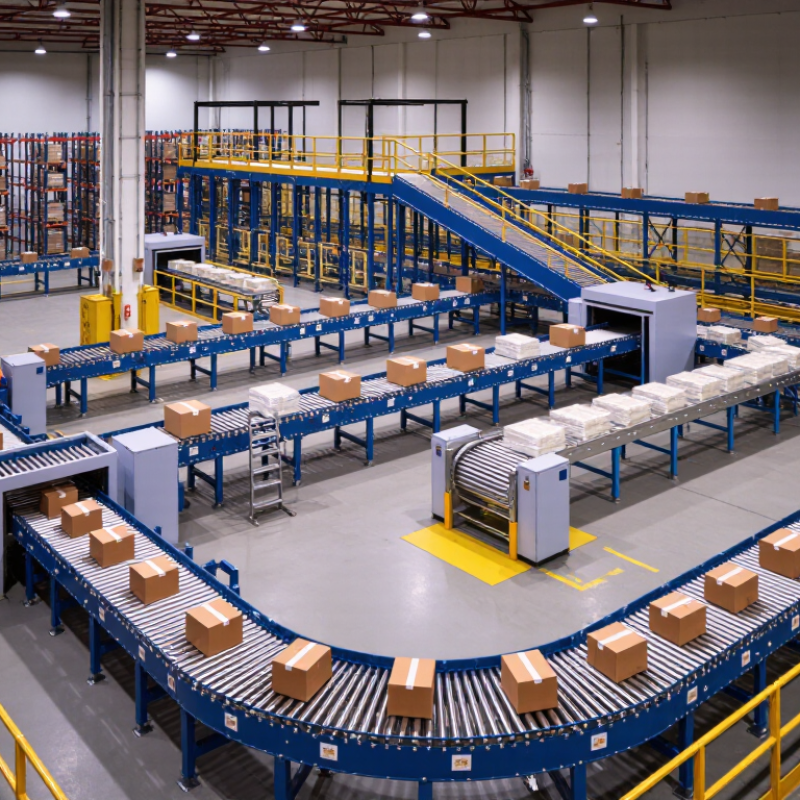
Warehouse conveyor speed is usually measured in meters per second or feet per minute. Light cartons may travel at 0.5 to 1.5 meters per second. Heavier loads often require slower movement. The correct speed depends on product size, weight, belt design, and workstation spacing.
In practical warehouse testing, operators watch how cartons enter, stop, and leave each zone. A box moving too quickly can slide at a transfer point. It may also miss a scanner or reach a worker before the station is ready. A slower belt can improve accuracy, but it may reduce hourly output. Many facilities adjust speed between zones instead of using one fixed setting.
Product shape matters more than many planning sheets suggest. Tall cartons can wobble. Soft packages can compress against guides. Dust, moisture, and uneven loading can also change belt performance. Sensors should be checked while products move at normal operating speed, not only during an empty-belt test.
A clean calculation is not enough.
Supervisors should record stoppages, damaged cartons, missed scans, and worker response time. These details reveal whether speed supports the whole operation. Sometimes a conveyor runs fast, yet orders move slowly because manual handling creates a bottleneck. A short trial with real products usually provides better evidence than a theoretical target. Even experienced teams can overlook this.
Product movement speed depends on more than motor power. Many package conveyors operate between 0.5 and 2.0 meters per second. However, the useful rate depends on product spacing, belt width, load weight, and transfer design. A small carton may move quickly, while a soft bag needs gentler handling. Inclines, merges, scanners, and automatic stops can also reduce the real throughput.
The 2023 MHI Annual Industry Report found that 83% of supply chain professionals expected to adopt robotics and automation within five years.
This trend increases pressure on conveyor systems, but higher speed is not always better. If cartons arrive too closely, scanners may miss labels. If acceleration is too sharp, products can rotate or fall. Engineers should measure actual throughput at receiving, picking, packing, and shipping points. A neat spreadsheet can still lie.
Tips: Test with real products, not empty cartons. Record speed, spacing, stoppages, and rejected scans for a full shift. Check the heaviest load and the smallest package separately.
Leave room for seasonal peaks, but question every assumption. A conveyor moving at 1.5 meters per second may look impressive, yet a poorly balanced line can deliver fewer usable cartons per hour.
Safety controls, operator visibility, and maintenance access must remain part of the speed decision.
Typical speed ranges vary by conveyor design, product weight, and required handling accuracy. CEMA engineering references commonly place belt conveyors around 60–300 feet per minute, or 0.3–1.5 meters per second. Motor-driven roller conveyors often operate between 50 and 250 feet per minute. Zero-pressure accumulation conveyors usually move more slowly, around 20–120 feet per minute, because cartons must separate safely before release. Cross-belt and tilt-tray sorters can reach 300–600 feet per minute, according to published warehouse automation benchmarks.
Speed is only one part of throughput. A 15-kilogram carton traveling quickly may still reduce output if gaps are inconsistent. Barcode scanners need stable presentation. Curves need controlled entry speeds. The 2024 MHI Annual Industry Report identifies throughput, labor availability, and automation investment as major warehouse concerns, but it does not support one universal conveyor speed. That matters.
Real installations often run below their mechanical limit. A belt rated for 300 feet per minute may operate at 180 feet per minute to reduce noise, product tipping, and missed scans. Field trials are essential. One overlooked carton size can expose a poor assumption. Even experienced engineers should recheck spacing, acceleration, and emergency stopping distances before increasing speed.
How Fast Can Warehouse Conveyors Move Products?
How Conveyor Speed Affects Safety and Efficiency
Warehouse conveyors can move products at different speeds, depending on product size, weight, layout, and task requirements. A light carton may travel smoothly at a faster rate, while unstable boxes need slower movement. Speed alone does not determine productivity. Poor spacing can create backups, damaged packages, and rushed handling.
Safety changes quickly when speed increases. Workers have less time to notice fallen items or remove damaged cartons. Fingers, loose clothing, and tools can also approach moving parts too quickly. Guarding, emergency stops, clear walkways, and regular inspections must match the conveyor’s operating speed. Sensor placement matters too. A sensor positioned too far from a transfer point may react late.
A practical test uses real cartons, not empty equipment. Run several package types through the line and measure stoppages, impact marks, worker reach distance, and queue length. Watch the transfer points closely. They often reveal problems first. In many facilities, a small speed reduction improves total output because fewer interruptions occur. That sounds inefficient, but the numbers can disagree with appearances. Workers may still need adjustable pace zones, especially near picking and packing stations. A faster setting can also increase fatigue during long shifts. The best speed is usually the highest stable speed, not the highest available setting. Yet this judgment should be reviewed after layout changes, seasonal volume increases, or new package designs.
How Fast Can Warehouse Conveyors Move Products?
Conveyor speed should be measured against throughput, not advertised maximums. A faster belt may create gaps, jams, or damaged cartons. In a practical audit, record belt speed, units per minute, spacing, stoppages, and motor load. A handheld tachometer can verify actual speed, while sensors can count products at entry and discharge points. Compare both readings during busy and quiet periods.
Adjustment should begin with small changes. Increase variable-frequency-drive settings gradually, then observe accumulation zones and transfer points. Measure productive runtime, not only motor operation. For example, 60 meters per minute means little if cartons stop for 12 seconds at every merge. The MHI 2024 Annual Industry Report found that 55% of surveyed organizations expected to increase technology investment. That investment needs credible measurements. CEMA engineering guidance also stresses matching conveyor capacity with loading conditions, belt characteristics, and control design. A clean number can still mislead.
Tips: Use a fixed test window, such as 30 minutes. Test full, half-full, and empty conditions. Record ambient temperature and carton size. Keep a manual count beside the automated counter. Errors happen. Review them before changing speed. If jams rise after a speed increase, reduce acceleration first, then inspect alignment, sensor timing, and operator loading habits. Report source: MHI, 2024 Annual Industry Report; Conveyor Equipment Manufacturers Association engineering guidance.
Light cartons often travel between 0.5 and 1.5 meters per second. Heavier or unstable loads usually need slower movement.
Product weight, size, shape, belt design, and workstation spacing all matter. A single fixed setting may not suit every zone.
Fast cartons may slide at transfers, miss scanners, or reach workers too early. These interruptions can lower total hourly output.
Higher speeds reduce reaction time. Workers may struggle to remove fallen cartons or avoid moving parts, especially during long shifts.
Guarding, emergency stops, clear walkways, and inspections should support the operating speed. Sensor placement also requires careful checking.
Empty-belt tests hide problems caused by wobbling, compression, dust, moisture, or uneven loading. Real packages show actual transfer behavior.
Record stoppages, damaged cartons, missed scans, queue length, and worker response time. Also watch impact marks near transfer points.
No. The best setting is usually the highest stable speed, not the highest possible speed. That sounds slower, but fewer interruptions may improve output.
Review it after layout changes, seasonal volume increases, or new package designs. Conditions change, and previous settings may become unreliable.
Yes. Practical assumptions can overlook manual bottlenecks or worker fatigue. A short trial with real products may reveal uncomfortable truths.
Warehouse conveyors can move products at different speeds depending on their design, layout, and operating purpose. The question “how fast can warehouse conveyors move products” does not have one universal answer, because speed is influenced by product weight, size, shape, spacing, conveyor length, incline, control systems, and required handling accuracy. Belt, roller, chain, and sortation conveyors may each operate within different typical speed ranges, with slower movement often preferred for heavy, fragile, or irregular items and faster movement used for lightweight packages and high-volume operations.
Conveyor speed directly affects warehouse safety, productivity, energy use, and product flow. Excessive speed can increase collisions, jams, product damage, and operator risk, while insufficient speed may create bottlenecks and reduce throughput. Performance can be evaluated by measuring travel time, throughput, spacing, accumulation, and downtime. Operators can then adjust speed through control settings, sensor feedback, variable-speed drives, and improved loading practices to maintain a balanced, efficient, and safe material-handling process.

Maith Conveyor