How do automated conveyors reduce labor costs? The answer begins with repetitive movement. Conveyors transport cartons, totes, pallets, and components through fixed routes. They reduce the need for employees to walk, lift, push, and carry materials between workstations. In a busy warehouse, that difference becomes visible quickly. A conveyor can move a box continuously, while a worker may complete only one trip at a time.
Bill Gates, a leading technology entrepreneur, wrote, “Automation applied to an efficient operation will magnify the efficiency.” This principle applies directly to conveyor systems. When scanners, sensors, and controls work together, conveyors can sort packages, regulate flow, and reduce idle labor. Fewer employees may be needed for material handling. Existing employees can focus on picking accuracy, quality checks, customer issues, or equipment supervision.
The savings are not limited to hourly wages. Companies may also reduce overtime, lifting injuries, training time, and productivity losses caused by long walking distances. A worker should not spend an entire shift pushing a cart across a concrete floor. That is expensive motion.
Still, automation is not a guaranteed shortcut. Poor layout planning can create bottlenecks, jams, and costly downtime. Conveyors also require installation, maintenance, electricity, and trained technicians. My practical view is less dramatic: automation reduces labor costs when it removes unnecessary movement without weakening operational control. The best results come from measuring travel time, throughput, staffing, and maintenance before investing. Otherwise, a company may automate confusion instead of improving work.
What Automated Conveyors Are and How They Work
Why Do Automated Conveyors Reduce Labor Costs?
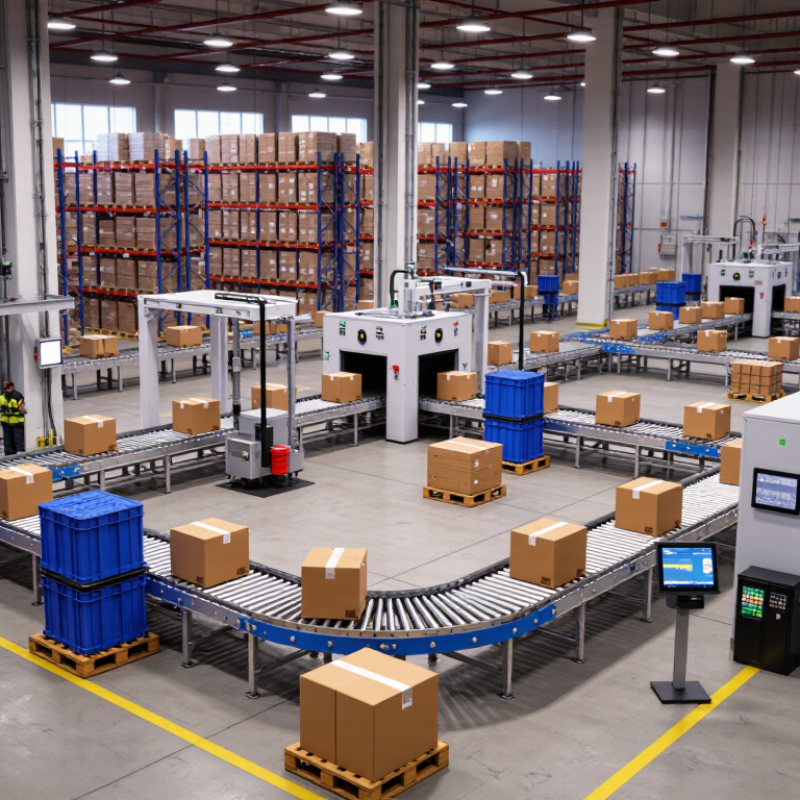
Automated conveyors are powered systems that move cartons, totes, or pallets between workstations. Belts, rollers, motors, sensors, and programmable controllers coordinate the movement. A photoelectric sensor detects a box, then signals the controller to start, stop, merge, or divert it. This replaces repeated walking and manual pushing with controlled material flow. Workers can focus on picking exceptions, quality checks, or machine support. The physical scene is simple: a carton leaves a packing bench, passes a scanner, and reaches shipping without an employee carrying it.
The financial effect comes from fewer handling hours and steadier output. The International Federation of Robotics reported 541,302 industrial robots were installed worldwide in 2023. Conveyors are not robots, but this figure shows how widely automated production is expanding. MHI’s 2024 Annual Industry Report also identified robotics and automation as a major investment area among supply-chain professionals. A conveyor may run for long periods with limited supervision, especially during repetitive shifts. Still, the calculation is not flawless. Installation, controls integration, energy use, and maintenance create upfront costs. Poor layout decisions can make a system expensive and awkward. Sensors also fail, sometimes at the worst moment. Reliable savings depend on throughput, product variety, labor rates, and proper preventive maintenance. Automation reduces labor costs most effectively when it removes unnecessary movement, not when it simply moves the same problem faster.
Which Manual Labor Tasks Automated Conveyors Reduce
Why Do Automated Conveyors Reduce Labor Costs?
Which Manual Labor Tasks Automated Conveyors Reduce
Automated conveyors reduce labor costs by removing repetitive movement across warehouses and production floors. Workers no longer walk long distances to collect cartons, totes, or components. That work is repetitive. Conveyors can transfer items between receiving, storage, picking, packing, and shipping areas with consistent timing. They also reduce manual carrying, lifting, sorting, staging, and handoff tasks. The U.S. Bureau of Labor Statistics continues to classify material-moving work as a major employment group, showing how much labor these activities require.
The savings are not limited to headcount. Fewer walking hours can increase productive time per shift. Conveyors can also reduce unnecessary bending and carrying, which may support safer workstation design. MHI’s 2024 Annual Industry Report found that 55% of supply chain leaders planned to increase technology and innovation investment. This indicates strong industry interest, but investment alone does not guarantee savings. Poor routing can create bottlenecks, idle operators, and expensive maintenance problems.
Manual labor still matters after installation. Employees may inspect damaged cartons, resolve jams, replenish materials, scan exceptions, and maintain equipment. McKinsey Global Institute estimates that about 50% of work activities are technically automatable, while fewer than 5% of occupations are fully automatable. Not everything disappears. Labor usually shifts toward supervision, quality control, and problem-solving. A conveyor reduces physical handling most effectively when its speed, layout, and workload match real operating conditions. That fit is often imperfect.
How Conveyor Automation Increases Workplace Productivity
In a busy distribution area, automated conveyors keep products moving between receiving, storage, and packing stations. Workers spend less time pushing carts or carrying boxes across long distances. They can focus on scanning, quality checks, order accuracy, and customer-specific requests. This shift often reduces labor costs through better use of existing staff, rather than simple headcount reduction.
Workplace productivity improves when movement becomes predictable. A steady conveyor flow can reduce waiting, crowded aisles, and repeated lifting. At one warehouse, supervisors noticed fewer pauses near packing benches after adding sensors and controlled speed zones. Workers handled more orders during each shift, while managers could identify bottlenecks through production data. Small changes mattered. Even moving a packing station closer to the conveyor reduced unnecessary steps.
However, automation is not effortless. The first layout may be inefficient, especially when product sizes change throughout the day. I have seen teams focus on conveyor speed while overlooking training and safe access points. That mistake can create new delays. Regular inspections, clear operating procedures, and practical worker feedback are essential. Maintenance staff also need time to respond before a minor belt issue affects the entire workflow. Automation supports people best when its design reflects real working conditions, not only projected output. Efficiency can improve, but it requires ongoing adjustment.
How Automated Conveyors Lower Labor-Related Operating Costs
Why Do Automated Conveyors Reduce Labor Costs?
How Automated Conveyors Lower Labor-Related Operating Costs
Automated conveyors reduce labor-related operating costs by removing unnecessary walking, carrying, and manual transferring. Workers can focus on quality checks, exception handling, and customer-specific tasks. The U.S. Bureau of Labor Statistics reported that benefits represented 29.9% of private-industry compensation in June 2024. Fewer manual hours can therefore reduce wages, overtime, and associated benefit costs. The savings are often visible beside the packing station.
Deloitte’s 2023 Smart Manufacturing and Operations Survey found that 86% of manufacturing executives viewed smart manufacturing investments as important for competitiveness. MHI’s 2024 Annual Industry Report also identified automation as a growing response to workforce challenges. Yet the calculation is rarely perfect. Conveyors require installation, maintenance, energy, and operator training. A poorly designed line can create a new bottleneck instead of lowering costs. Experience from warehouse projects shows that accurate product data and balanced conveyor speeds matter as much as the equipment itself.
Tips: Measure walking distance, overtime, and manual touches before automation. Track labor hours per order after installation. Keep a manual bypass for maintenance periods. Review jam frequency weekly. Do not assume maximum speed produces maximum savings. A slower, balanced conveyor may protect product quality and prevent expensive rework. These details are easy to overlook.
Why Do Automated Conveyors Reduce Labor Costs?
Estimated monthly labor cost for processing 100,000 units. The model uses a fixed labor rate of $22 per hour and shows how automation reduces the number of direct handling hours required.
Automated conveyors reduce labor-related operating costs by lowering repetitive manual handling requirements. In this modeled scenario, required labor hours fall from 832 hours with fully manual handling to 208 hours with an automated conveyor system.
What Factors Determine Conveyor Labor-Cost Savings
Why Do Automated Conveyors Reduce Labor Costs?
What Factors Determine Conveyor Labor-Cost Savings
Automated conveyors reduce labor costs by changing how people spend each shift. The savings depend on more than installing moving belts. Throughput, product weight, layout, maintenance, and staffing patterns all matter.
In facility assessments, time studies often reveal hidden labor expenses. Workers may spend minutes walking between picking and packing areas. A conveyor can shorten these trips and reduce repeated lifting. Reliable analysis should measure scanning, loading, jam clearing, and supervision. Ignoring these tasks creates inflated savings claims. That mistake is common.
Labor savings are strongest when volume is steady and routes are repetitive. Seasonal operations may need flexible staffing when equipment utilization falls. The number of shifts matters too. A system used sixteen hours daily usually spreads its fixed cost more effectively than one used four. Training, preventive maintenance, energy use, repairs, and downtime belong in the calculation. Unexpected jams happen. Real facilities rarely behave perfectly. A pilot period can expose weak assumptions before a full investment. Managers should compare baseline labor hours with actual post-installation results, not projected output alone. Worker safety, fatigue, and error rates also influence the real value of the system.
Why Do Automated Conveyors Reduce Labor Costs? - What Factors Determine Conveyor Labor-Cost Savings
| Conveyor Application |
Manual Workers per Shift |
Workers After Automation |
Annual Labor Hours Before |
Annual Labor Hours After |
Labor-Hour Reduction |
Loaded Labor Rate |
Estimated Annual Gross Savings |
| Pallet transport between receiving and storage |
4 |
1 |
20,000 |
5,000 |
75% |
$24/hour |
$360,000 |
| Parcel sorting and diverting |
10 |
3 |
50,000 |
15,000 |
70% |
$26/hour |
$910,000 |
| Carton accumulation and order consolidation |
6 |
2 |
30,000 |
10,000 |
67% |
$25/hour |
$500,000 |
| Food and consumer-goods packaging transfer |
5 |
2 |
25,000 |
10,000 |
60% |
$23/hour |
$345,000 |
| Work-in-process movement in manufacturing |
3 |
1 |
15,000 |
5,000 |
67% |
$27/hour |
$270,000 |
| Returns inspection and routing |
4 |
2 |
20,000 |
10,000 |
50% |
$24/hour |
$240,000 |
| Illustrative Average |
5.3 |
1.8 |
27,500 |
9,167 |
65% |
$24.83/hour |
$437,500 |
Calculation basis:
Illustrative planning figures assume two shifts per day, five operating days per week, 50 operating weeks per year, and 5,000 conveyor operating hours annually. Loaded labor rates include wages and typical employer-related labor costs. Annual gross savings equal avoided labor hours multiplied by the loaded labor rate; maintenance, energy, training, and capital costs are excluded.
Conclusion
Automated conveyors are material-handling systems that move products, components, or packages along a planned route with limited manual control. Using motors, sensors, controls, and coordinated movement, they can transport items between workstations, storage areas, and shipping points. This automation reduces repetitive tasks such as lifting, carrying, pushing, sorting, and transferring materials, allowing employees to focus on quality checks, equipment monitoring, problem-solving, and other higher-value responsibilities.
So, how do automated conveyors reduce labor costs? They increase workplace productivity by maintaining a steady material flow, reducing delays, minimizing manual handling errors, and helping fewer workers manage larger production volumes. They can also lower labor-related operating costs by reducing overtime, physical strain, injury risks, training demands, and the need for constant material movement. However, actual savings depend on factors such as conveyor design, operating hours, throughput, facility layout, maintenance requirements, wage levels, and the degree of automation. Careful planning is essential to ensure that the investment delivers lasting labor and efficiency benefits.

 Maith Conveyor