Can conveyor systems handle heavy pallets? In many facilities, yes—but the answer depends on more than the pallet’s stated weight. A loaded wooden pallet may place several hundred kilograms on a short section of conveyor, especially when its boards are uneven or its load shifts during transfer. Conveyor selection must account for pallet weight, dimensions, support points, travel speed, and how often pallets arrive. Small details matter.
Roller conveyors, chain-driven systems, and heavy-duty belt conveyors each suit different handling conditions. Roller spacing must support the pallet’s underside without letting boards sag between rollers. Frames, bearings, motors, and transfer points also need ratings appropriate to the real operating load, not just an ideal test case. A sharp impact at a merge can create stress that a steady, centered load does not. That gets overlooked.
A reliable assessment starts with measured pallet loads and a review of the full route, including starts, stops, turns, and accumulation zones. Site conditions matter too: dust, moisture, temperature, and maintenance access can affect performance over time. Manufacturers can help verify capacity and recommend suitable components, but their guidance should be checked against actual operating conditions. No single conveyor fits every pallet. Even a system that handles the weight may struggle with damaged runners or an unstable stack. That is the part worth questioning before installation. With careful sizing, sound controls, and routine inspection, conveyor systems can move heavy pallets safely and consistently—provided the entire system is designed for the load.
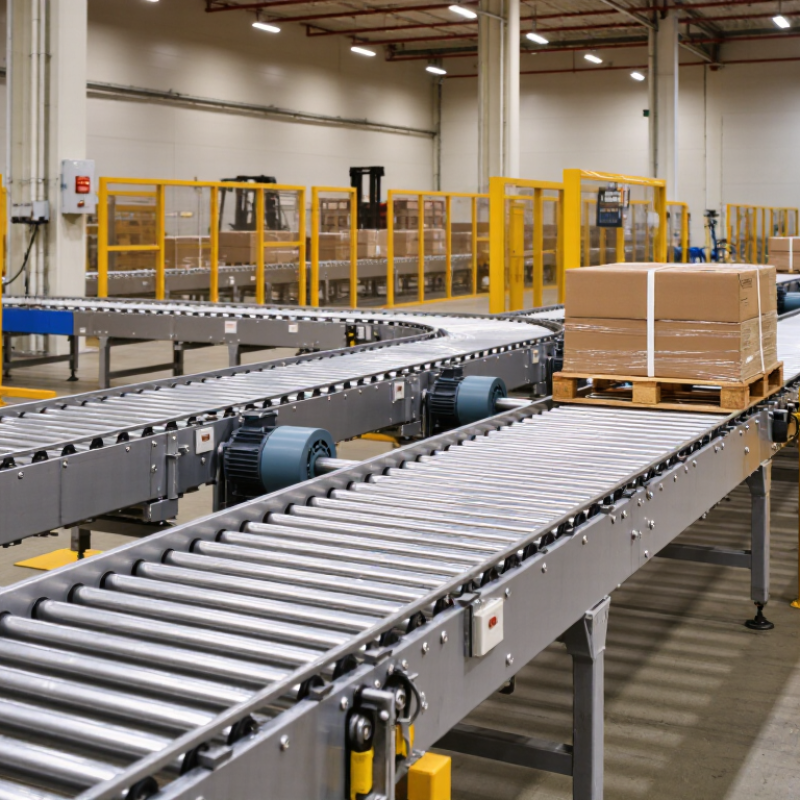
A heavy pallet is not defined by weight alone. Operators should compare the fully loaded pallet’s mass with the conveyor’s rated capacity per pallet and per metre. A 900-kilogram load may be acceptable on a roller bed designed for it, yet unsafe on a light-duty zone. Check pallet dimensions, underside gaps, and how weight sits across the deck. A narrow stack of steel parts can concentrate force on a few rollers. An uneven load can shift during a start or transfer. The quoted weight is only part of the picture. Not quite enough.
Tips: Weigh the loaded pallet, including the pallet itself. Check capacity at curves, lifts, stops, and accumulation zones; these points may have different limits. Keep the load centered and test the heaviest expected pallet under controlled conditions. Look for rocking, roller deflection, or delayed movement. Small clues matter.
Classification should reflect real operating conditions, not an ideal static test. Consider repeated starts, tight spacing, and impacts from manual loading. These forces can increase demand beyond a simple stationary rating. Inspect pallets too: broken runners or loose boards affect support and stability. If the rating or pallet weight is unclear, verify it before increasing throughput. In practice, “heavy” begins when the load approaches a component’s safe rating. That boundary deserves review, especially when loads vary. It is not always obvious.
Heavy pallets need more than a powerful motor. The conveyor must support the pallet’s weight, footprint, and load distribution. Powered roller conveyors suit rigid pallets with flat, stable undersides. Their rollers carry concentrated loads while allowing controlled movement between zones. Chain-driven conveyors work well for transfers, especially when pallets move across the line. For continuous support, a heavy-duty belt can help accommodate uneven undersides, though belt friction and heat may need review. Check rated capacity under operating conditions, not just maximum static load. Starts, stops, and closely spaced pallets can increase stress.
Tips: Measure the heaviest loaded pallet and inspect its underside. Confirm roller spacing supports the pallet’s runners. Include transfer points, braking, and emergency stops in the layout review.
Small details matter. A pallet that clears the conveyor on paper may catch at a transfer plate. Allow room for alignment guides and maintenance access. Ask operators how pallets arrive; damaged boards and shifting loads are common surprises. I’ve seen designs focus on weight while overlooking pallet width. That can mean jams. Recheck the layout after a real pallet trial, because calculations alone may miss awkward movement.
A conveyor’s load capacity is not set by its strongest component. It is limited by the weakest point along the route. Engineers check the pallet’s total weight, footprint, and how evenly its contents sit. A 900-kilogram pallet with weight concentrated near one edge can stress rollers differently from a balanced load of the same mass. That detail matters.
Rollers, bearings, frames, supports, and drive units each have their own limits. The calculation must also account for movement, not just a stationary pallet. Starting and stopping create extra forces, while inclines demand more drive torque. Curves and transfer points can shift loads sideways. Closely spaced pallets may also create accumulation pressure if one stops unexpectedly. Not just weight.
A practical assessment follows the full path, including joints and loading areas, where impact can be higher. Engineers compare component ratings with the expected load pattern and operating speed, then allow a suitable safety margin. The exact margin depends on the system and use; a single rule of thumb is rarely enough. A tidy spreadsheet can still miss a poorly supported frame or a pallet with uneven feet. That is worth checking on site. Regular inspections can reveal loose fasteners, worn rollers, or damage that changes how loads travel.
| Capacity factor | What is assessed | Illustrative design case | Why it matters |
|---|---|---|---|
| Gross pallet load | Combined mass of the pallet, goods, and packaging | Example: 1,200 kg per loaded pallet | This is the starting load, not necessarily the final design load. |
| Design allowance | Allowance for starting, stopping, transfers, and operating conditions | A project might assess a 1.3 factor: 1,200 kg × 1.3 = 1,560 kg equivalent design load | The appropriate factor depends on the application and should be set by the system designer. |
| Roller or chain rating | Rated capacity of rollers, axles, chains, sprockets, and their connections | Check each component against its actual share of the design load | The pallet weight is distributed unevenly; the weakest load-bearing component can limit the section. |
| Load support and pitch | Pallet dimensions, roller spacing, and the number of rollers supporting the pallet | A common design check is to maintain support on at least three rollers along the direction of travel | Insufficient support or a weak pallet deck can cause sagging, instability, or concentrated loads. |
| Frame and supports | Frame strength, support-leg spacing, joints, and floor anchoring | Verify the conveyor at the specified support spacing and operating load | A strong roller does not compensate for an undersized frame or poorly supported conveyor. |
| Drive and traction | Motor, gearbox, chain or belt, slope, acceleration, and friction | Calculate the force needed to move the total number of pallets, especially on inclines or during accumulation | A conveyor may support a pallet structurally but still lack the drive capacity to move it reliably. |
| Transfers and accumulation | Transfer plates, stops, turns, lift points, and the number of pallets queued together | Check local loads at transitions and the drive demand under the intended accumulation mode | Loads can concentrate at transfer points; zero-pressure and contact accumulation have different requirements. |
| Operating environment | Temperature, moisture, dust, corrosion, washdown, and duty cycle | Use components and ratings suitable for the actual site conditions and hours of operation | Environmental conditions can affect materials, lubrication, traction, and service life. |
| System capacity | Lowest allowable capacity among all relevant sections and components | Confirm the complete route, including curves, merges, transfers, and accumulation zones | The system’s usable capacity is limited by its weakest section, not its strongest component. |
Note: The figures above are illustrative design examples, not equipment ratings or a universal safety standard. Confirm allowable loads with the conveyor supplier or a qualified engineer using the pallet’s dimensions, load distribution, operating conditions, and applicable local requirements.
A conveyor may carry a heavy pallet safely only when its capacity matches the real operating conditions. Check the rated load for each conveyor section, not just the system’s overall rating. Starting, stopping, and accumulated pallets can place extra stress on rollers, chains, frames, and drive components. That matters. A pallet that weighs less than the stated limit may still create an unsafe load if its weight is unevenly distributed.
Pallet condition is easy to overlook. Broken boards, protruding nails, or a warped base can catch between rollers and shift the load. Confirm that pallet dimensions and bottom supports suit the conveyor surface. Keep heavy loads centered, and use guides or stops where movement could cause a collision. Sensors and emergency stops should be accessible and tested regularly. Guards must prevent contact with moving parts without blocking safe inspection.
Operators need clear procedures for jams and unusual noises. Never assume a stalled pallet is stable; stored force can release when it moves. Inspect anchors, joints, and wear points on a schedule suited to the duty cycle. A checklist helps, but it can miss changes in pallet quality or loading habits. Review those conditions in person, and have a qualified engineer assess the system before increasing load limits or throughput.
A heavy-duty conveyor should be selected for the pallet’s real operating conditions, not its average weight. Record the heaviest load, pallet dimensions, hourly volume, and how often pallets stop or restart. A concentrated load on a damaged pallet can stress rollers more than a lighter, evenly supported one. Leave capacity margin, and ask a qualified conveyor engineer to check drive torque, frame strength, and transfer points. Those details matter.
Choose rollers or a belt based on the pallet base and the route. Roller systems need suitable spacing so pallet boards remain supported; belt systems may suit loads that need continuous contact. Check floor space, incline, washdown needs, and access for repairs. It is easy to focus on rated capacity and overlook a tight turn or uneven floor. That can be an expensive oversight.
Maintenance should follow the equipment maker’s schedule and the site’s actual duty cycle. Inspect rollers, bearings, chains, belt tracking, fasteners, and guards for wear or movement. Listen for new rattling, and note unusual heat near bearings or motors. Check it weekly. Keep a simple log of noise, temperature, repairs, and load changes. One limitation: visual checks may miss internal wear, so persistent changes deserve a closer inspection before a fault stops production.
Capacity depends on the weakest component along the route, including rollers, bearings, frames, supports, and drives. Engineers assess load weight, pallet size, and weight distribution.
No. A 900-kilogram pallet loaded heavily on one edge can stress rollers more than a balanced pallet of equal weight. Not weight alone.
Starting and stopping add forces, while inclines require more drive torque. Curves and transfer points can shift loads sideways. That matters.
Check joints, loading areas, supports, and transfer points, where impact or poor support may create extra stress. A tidy spreadsheet can still miss a loose joint.
Yes. Broken boards, protruding nails, or a warped base may catch between rollers and shift the load. Check the pallet’s underside, too.
Record the heaviest load, pallet dimensions, hourly volume, and how often pallets stop or restart. Match rollers or belts to the pallet base and route.
Inspect rollers, bearings, chains, belt tracking, fasteners, guards, and anchors. Listen for new rattling and note unusual heat near bearings or motors. Keep a simple log.
Follow clear site procedures and do not assume a stalled pallet is stable. Stored force may release when it moves. Get persistent changes inspected.
Can conveyor systems handle heavy pallets? Yes, when the equipment is selected and configured for the load. A heavy pallet is defined not only by its total weight but also by its dimensions, load distribution, and how it contacts the conveyor. Roller, chain, and other heavy-duty conveyor designs can suit different pallet types and operating conditions, but each system must be evaluated as a complete line rather than by a single component.
Capacity depends on factors such as pallet weight, conveyor width and length, support spacing, drive power, speed, and the number of pallets moving at once. Safe operation also requires stable loading, suitable guarding, clear operating procedures, and regular inspections. To choose and maintain a reliable system, assess current and expected loads, match the conveyor design to the workflow, and monitor wear on rollers, chains, motors, and structural supports.

Maith Conveyor