Small warehouses face a deceptively simple question: are conveyor systems worth it for small warehouses? The answer depends less on building size than on movement patterns, labor costs, order volume, and growth plans. A 30-meter conveyor may save hours each day, yet become expensive equipment if workers still walk around bottlenecks.
Industry data shows why this decision deserves careful measurement. MHI’s 2024 Annual Industry Report found that 34% of supply-chain professionals currently use robotics and automation, while 61% expect adoption within five years. The report reflects broad industry activity, not small-warehouse results. That limitation matters. DHL’s 2024 “The Logistics Trend Radar” also identifies robotics and automation as major logistics trends, but technology alone does not guarantee a faster operation.
Warehouse automation consultant Kevin Lawton offers a useful principle: “Start with the problem, not the machine.” This means tracking walking distance, picking errors, hourly throughput, and peak-season labor before requesting supplier quotes. Watch the real floor. A worker carrying three cartons may reveal more than a polished presentation.
The strongest case usually involves repetitive routes, stable product dimensions, and rising order frequency. The weaker case involves irregular inventory, low daily volume, or frequent layout changes. Even then, the conclusion is not always obvious. A short conveyor, roller track, or modular system might fit better than a fully automated line. Careful testing beats enthusiasm. Small warehouses need practical returns, not impressive machinery.
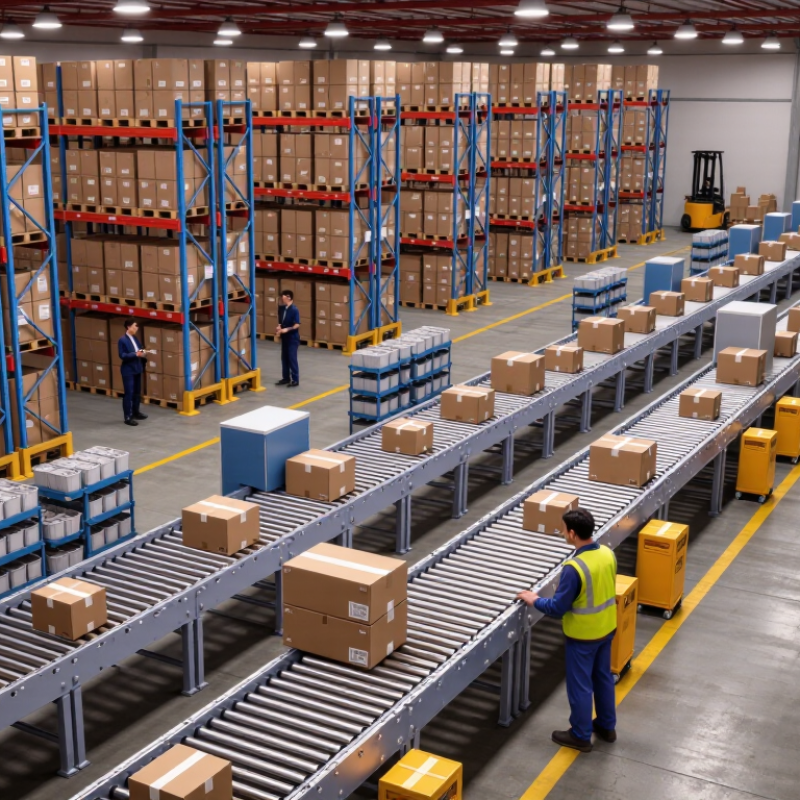
A conveyor system is a powered or gravity-driven path for moving cartons, totes, or parcels. In a small warehouse, it creates a controlled route between receiving, storage, picking, and packing areas. A motor drives the belt or rollers, while sensors track items and regulate movement. Workers place packages onto the line, and the system carries them at a steady pace. That rhythm matters. It can reduce walking, limit manual lifting, and make order flow easier to observe. However, conveyors do not remove every handling problem. Poorly sized packages may jam the line, and fragile items may need slower movement.
Before installation, measure aisle width, ceiling height, package sizes, and daily order volume. A narrow warehouse may benefit from a short, straight conveyor instead of a complex layout. Curves, merges, and elevation changes require more space and maintenance access. Gravity rollers can suit light cartons and low-volume work, while powered sections offer better control during busy periods. Safety features should include emergency stops, guarded moving parts, clear walkways, and regular inspections.
In practice, operators often discover that the conveyor becomes a bottleneck near packing stations. Small spaces punish poor planning. I would not assume a longer conveyor always improves productivity. A compact line with well-positioned workstations may perform better. The design should also allow workers to reach blocked packages quickly, because even a brief obstruction can interrupt the entire workflow.
Typical planning throughput by conveyor type for small-warehouse applications
Belt and powered roller conveyors generally provide higher continuous throughput, while flexible conveyors are useful where layouts change frequently or loading points are temporary. A small warehouse is more likely to benefit from conveyors when order volume is repetitive, travel distances are long, and the available space supports safe access and maintenance. The figures shown are typical planning ranges; actual capacity depends on item size, spacing, conveyor speed, routing, and operator workflow.
Small warehouses often benefit from conveyor automation when daily tasks involve repeated movement between fixed zones. Receiving teams can move cartons from unloading areas to inspection tables with less walking. Pickers also gain value when conveyors connect storage aisles with packing stations. This works especially well for steady orders with similar carton sizes.
Packing is another strong use case. A conveyor can deliver picked items, hold completed parcels briefly, and reduce floor congestion. Sortation helps when orders leave through several shipping routes. Replenishment tasks may also improve, especially when stock travels from a reserve area to fast-moving shelves. Returns processing can benefit from a dedicated line, but only when inspection steps remain easy to access.
I once assumed faster movement always meant better output. That assumption was wrong. Poorly placed conveyors can create waiting points, noise, and awkward manual handling.
Tips: Measure walking time before choosing equipment. Observe one full shift, including busy periods. Leave clear access around emergency exits and workstations. Use simple conveyors first, then expand after reviewing real data. Small warehouses often need flexibility more than maximum speed. Manual handling may still be better for irregular cartons, fragile items, or changing product mixes. A practical trial with temporary measurements can reveal problems that a layout drawing misses. Test the slowest task, not only the easiest one.
How to Know If Conveyor Systems Suit Small Warehouses?
For a small warehouse, conveyor suitability starts with space, not equipment. Measure clear floor area, ceiling height, columns, doors, and emergency access. A two-meter aisle may look generous on paper, yet become tight beside packing benches. In site assessments, I mark pedestrian routes with tape before discussing conveyor length. This exposes blind corners and blocked access points quickly. Keep room for maintenance. That space is often forgotten.
Tips: Map material flow from receiving to storage, picking, packing, and dispatch. Record carton dimensions, weights, daily volume, and peak-hour surges. Watch the real process for one full shift. Flow charts can hide pauses, returns, and manual handling. Choose a layout that reduces crossing paths, not merely travel distance. Test a short section first. An imperfect pilot can reveal noise, accumulation, or awkward operator movements before full installation.
Small warehouses need flexible layouts. Consider modular sections, adjustable speeds, and access gaps near workstations. Check whether the conveyor handles your smallest and largest loads safely. Light cartons may drift, while heavy cartons may stop on slight inclines. Controls should remain visible and simple for trained staff. Do not sacrifice fire routes or safe lifting posture for extra throughput. I have seen promising plans fail because replenishment traffic was ignored. Re-measure after seasonal changes. Demand rarely stays tidy.
| Evaluation Dimension | What to Measure | Typical Planning Benchmark | Why It Matters for a Small Warehouse | Evaluation Result |
|---|---|---|---|---|
| Available Floor Area | Usable area after deducting offices, columns, fire exits, battery-charging zones, and fixed equipment. | Reserve approximately 15–25% of usable floor area for aisles, access, maintenance, and safety clearance. | A conveyor can improve movement, but it may reduce flexible storage space if the footprint is too large. | Suitable when access remains clear |
| Ceiling Height | Clear height from the finished floor to lighting, sprinklers, beams, ductwork, or other obstructions. | Allow the conveyor elevation plus product clearance, sprinkler clearance, and safe service access. | Low ceilings may favor floor-level, overhead-free, or short inclined conveyor layouts instead of multi-level systems. | Verify obstruction clearance |
| Layout Geometry | Distance between receiving, storage, picking, packing, dispatch, and returns areas; include columns and emergency routes. | A straight or simple L-shaped route usually requires less space and is easier to maintain than a complex loop. | Simple routing reduces transfer points, installation cost, product damage risk, and lost floor flexibility. | Favorable for simple routes |
| Aisle and Walkway Access | Clear width for pedestrians, carts, pallet trucks, forklifts, and emergency access. | Set final aisle widths according to local safety rules, vehicle type, turning radius, and site risk assessment. | Conveyors should not create pinch points or force workers to cross moving lines unnecessarily. | Confirm local safety requirements |
| Order Volume | Orders per hour, items per order, peak-hour demand, and seasonal volume variation. | Compare peak demand—not average demand—with the conveyor's rated throughput and planned operating hours. | A system sized only for average volume may become a bottleneck during promotions or seasonal peaks. | Size for peak demand |
| Load Characteristics | Product dimensions, weight, packaging rigidity, surface condition, fragility, and load stability. | Keep the actual load range within the conveyor's specified minimum and maximum dimensions and weight. | Inconsistent cartons, soft packages, or unstable loads may require guides, transfers, accumulation, or manual handling. | Validate with representative loads |
| Material Flow Pattern | Whether products move continuously, in batches, one way, two ways, or between multiple workstations. | Conveyors are most effective when the flow is repetitive, predictable, and concentrated between fixed points. | Intermittent or highly variable movement may be better served by carts, pallet trucks, or modular equipment. | Best for repeatable flows |
| Accumulation Requirement | Temporary buffer needed before packing, labeling, inspection, staging, or dispatch. | Define the required buffer by peak arrivals, processing time, and allowable waiting time. | Without sufficient accumulation, a short stoppage at one workstation can stop the entire material flow. | Calculate buffer capacity |
| Manual Touchpoints | Number of loading, picking, scanning, sorting, packing, and unloading activities. | Prioritize conveyor sections that remove repetitive transport rather than replacing tasks that require judgment or flexibility. | Small warehouses often gain more value from targeted transport automation than from a fully integrated line. | Target repetitive travel |
| Change Frequency | How often storage locations, product mix, process steps, or shipping destinations change. | Frequent changes favor modular, movable, or expandable conveyor sections. | A fixed conveyor may become unsuitable if the warehouse layout or operating model changes regularly. | Consider modular design |
| Power and Controls | Available electrical capacity, control-panel location, sensors, emergency stops, network connectivity, and integration needs. | Provide accessible isolation points and emergency-stop coverage appropriate to the complete conveyor route. | Insufficient power or complicated controls can increase installation time and make troubleshooting difficult. | Check site infrastructure |
| Maintenance Access | Access to motors, rollers, belts, sensors, guards, transfer points, and cleaning areas. | Maintain safe service access around key components and avoid placing equipment directly against inaccessible walls. | Limited access can increase downtime and make a compact system more expensive to operate. | Plan service zones early |
| Safety and Ergonomics | Guarding, nip points, noise, manual lifting, reach distance, pedestrian interaction, and emergency stopping. | Complete a documented risk assessment and comply with applicable machinery, workplace, and fire-safety regulations. | Automation should reduce unsafe travel and lifting without introducing new entanglement or collision hazards. | Mandatory design review |
| Business Flexibility | Expected growth, product changes, relocation plans, and ability to expand the conveyor route. | Leave physical and control-system capacity for likely growth rather than designing only for current volume. | A scalable system can protect the investment when a small warehouse grows or changes its fulfillment process. | Prefer expandable solutions |
| Economic Fit | Installed cost, labor savings, throughput improvement, maintenance, energy use, downtime, and useful service life. | Compare the total cost of ownership with manual alternatives and include peak-season labor and productivity effects. | A conveyor is more likely to fit when it solves a persistent transport bottleneck rather than a short-term workload spike. | Complete a total-cost comparison |
| Planning note: The benchmarks above are general design guidelines, not universal code requirements. Final dimensions, guarding, emergency access, electrical work, and fire clearances should be verified by a qualified designer against local regulations and the warehouse's actual risk assessment. | ||||
A conveyor can suit a small warehouse, but its price extends beyond the equipment. Budget for design, installation, electrical work, safety guarding, and operator training. A short conveyor may still require floor changes or relocated shelving. Ask for a full installed-cost estimate, not only a purchase price. Compare that figure with reduced walking time, fewer lifting tasks, and potential labor savings. The payback calculation should use realistic order volumes, not an optimistic sales forecast.
Capacity must match the busiest hour, not the daily average. Measure cartons per minute, product dimensions, weight, and the number of order lines. A system handling 600 cartons daily may fail during a two-hour dispatch peak. Leave room for growth, but avoid buying excessive capacity that occupies valuable floor space. Small warehouses often need flexible sections, adjustable speeds, and manual work areas near packing stations. Bottlenecks can move elsewhere.
Maintenance deserves equal attention. Check access to motors, sensors, belts, and emergency stops before installation. Replacement parts should be available through dependable local channels. Ask how quickly trained technicians can respond after a breakdown. A simple cleaning schedule prevents dust from affecting sensors, though this task is often underestimated. Staff need practical training, not just a handover manual.
One honest warning: projected labor savings may not appear immediately. Poor layout, uneven carton flow, or weak discipline can erase expected gains. A trial run with real orders usually reveals more than a polished proposal.
Choosing a conveyor for a small warehouse starts with workflow, not available technology. Map each movement from receiving dock to storage, picking, packing, and dispatch. Record cartons per hour, walking distance, product dimensions, and peak-season volume. The 2024 MHI Annual Industry Report reported that 55% of respondents planned to increase automation investment. That figure signals opportunity, not automatic suitability.
A conveyor usually fits when the same route carries steady volumes every day. It may reduce walking and improve handoff consistency. Watch a picker pushing a cart through a narrow aisle. If the cart repeatedly stops at packing, a short powered section may help. Measure the baseline first. Include purchase cost, installation, controls, electricity, inspections, and downtime. Industry experience shows that small facilities often underestimate relocation costs. I have seen attractive payback calculations fail because seasonal demand was treated as normal demand.
Product variation matters too. Fragile cartons, irregular parcels, and frequent order changes can require transfers, sensors, or manual bypasses. The system also needs safe access around pinch points and emergency stops, following applicable workplace-safety requirements. Compare the conveyor’s annual capacity with a simpler option, such as improved shelving, batch picking, or better cart routes. The 2024 report also identifies labor pressure as a major supply-chain concern, but labor savings should be tested against real local wages and staffing patterns. Start with a measurable bottleneck. Avoid automating confusion.
Repeated carton movement between fixed zones benefits most. Receiving, picking, packing, replenishment, and sortation are common examples. Manual handling may still work better for irregular cartons. Keep it simple.
Receiving teams can move cartons from unloading areas to inspection tables. This reduces walking across the warehouse floor. The layout must keep inspection points easy to reach. Otherwise, cartons may wait unnecessarily.
Yes, especially when storage aisles connect directly with packing stations. Picked items can travel toward packing without repeated cart movement. A conveyor may also hold completed parcels briefly. It can reduce floor congestion.
Steady orders with similar carton sizes are usually suitable. Daily movement should follow repeated routes. Frequent product changes can reduce the benefit. Not always.
Measure cartons per minute during the busiest hour. Do not rely only on daily averages. Record carton size, weight, order lines, and peak-season volume. A system handling 600 cartons daily may still fail during a two-hour dispatch peak.
Include equipment, design, installation, electrical work, guarding, training, and floor changes. Also consider controls, electricity, inspections, and downtime. Request the full installed cost. The purchase price alone is misleading.
Observe one complete shift, including busy periods. Record walking time, waiting points, lifting tasks, and carton flow. Run a trial with real orders before expanding. Payback estimates can fail when seasonal demand is treated as normal demand.
Check access to motors, sensors, belts, and emergency stops. Create a simple cleaning schedule for dust around sensors. Keep replacement parts available through dependable local channels. Staff need practical training, not only a manual.
Leave clear access around emergency exits and workstations. Protect pinch points and keep emergency stops reachable. Avoid placing conveyors where workers must twist or carry awkwardly. Poor placement creates new problems.
No. Start with the clearest bottleneck, not the easiest task. Test the slowest operation and watch where queues form. My earlier assumption was wrong: faster movement does not always mean better output.
Conveyor systems can help small warehouses move cartons, totes, and parcels more efficiently by creating a continuous, organized flow between receiving, storage, picking, packing, and shipping areas. They are especially useful for repetitive tasks, high-order-volume operations, and workflows where employees spend significant time walking or manually transporting goods. However, their value depends on whether the warehouse has enough space, a suitable layout, and consistent material movement to justify automation.
Before investing, warehouse managers should evaluate available floor and overhead space, traffic paths, load sizes, throughput needs, installation costs, energy use, safety requirements, and ongoing maintenance. A conveyor may improve productivity and reduce handling effort, but it can also limit layout flexibility and require regular inspections and repairs. Ultimately, are conveyor systems worth it for small warehouses? The answer depends on order volume, labor challenges, growth plans, and whether the expected efficiency gains outweigh the system’s total ownership costs.

Maith Conveyor